This case study summarizes our published work in Frontiers in Genetics (2026). Read the full paper: https://doi.org/10.3389/fgene.2026.1653878
Highlights
- 297 admixed beef heifers from the NDSU Dickinson Research Extension Center, with 16 reproductive, body size, and carcass ultrasound phenotypes as explained earlier, with cattle breed structure in Anas M et al., 2025 (available here).
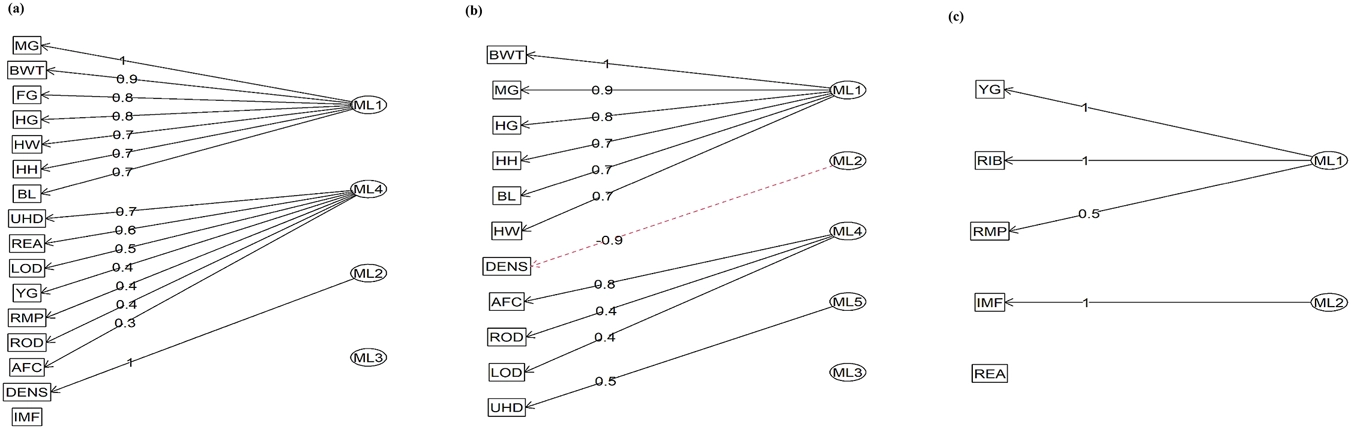
- Latent traits (called underlying biological traits, or UBTs) such as body size, body composition, ovary size and yield grade were taken from earlier factor analysis and tested in a genome-wide association study.
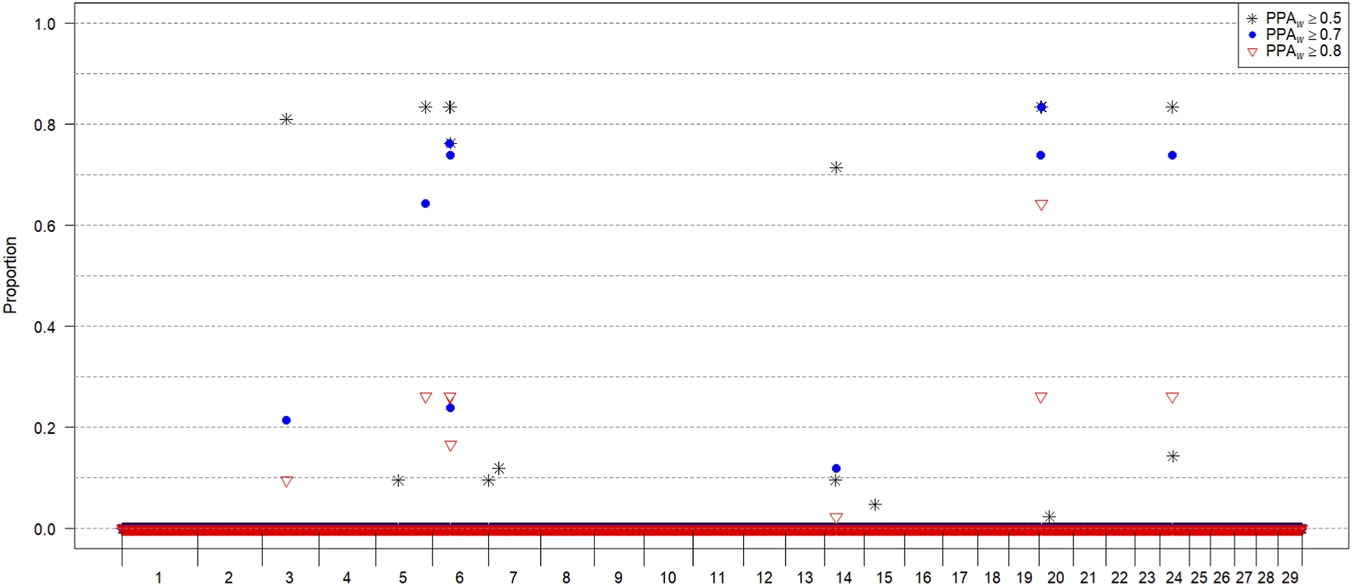
- Univariate, multi-trait and structural equation models all pointed to the same nine genomic windows, holding 1,911 SNPs and 98 mapped features.
- Heritability of the latent traits ranged from 0.46 to 0.84, higher than most single-trait estimates reported before for reproductive and carcass traits.
- Known and already reported growth and carcass genes were found associated with regions, including NCAPG, LCORL, and FAM184B.
Methodology
Beef heifers and cattle breeds structure
The herd included admixed beef cattle breeds. Most heifers were influenced, meaning at least half of their genome shared with Red Angus, Angus, American Aberdeen, Simmental, Gelbvieh, Shorthorn, or Limousin, and 33 were first crosses (F1) of purebred breeds. The heifers went through a 105-day feeding trial as yearlings between 2015 and 2018. Ultrasound data on ovaries, uterus and carcass were paired with body measurements like heart girth, hip height and body length. Some carcass records were lost, so we adopted two models: one with every trait on 161 heifers, and one that split reproductive and body size data (297 heifers) from carcass data (161 heifers).
All animals were genotyped on the GeneSeek Genomic Profiler 150K panel. After quality control, 115,388 SNP markers were used for GWAS analysis using the BayesB model in the JWAS package, using 1 Mb windows. A window was counted as associated when its posterior probability of association reached 0.8 (0.7 was also reported, given the small sample). More of this work is listed on my research and publications page.
Results
- Body weight was the most heritable trait (0.84). Yield grade, as a latent trait and as a direct measure, was the least heritable (about 0.46 to 0.47).
- Genetic correlations between latent traits were weak, so their intervals overlapped zero.
- Only the model 1 structural equation analysis found a causal link (body size to body composition) where the interval stayed above zero.
- Six of the nine windows came up again and again across different pi (π) settings. Body density associated with many of them, even though it never grouped into a latent trait.
- Enrichment analysis found 13 significant GO terms, mostly cellular components and calcium ion binding. The KEGG pathway for ECM–receptor interaction pulled in IBSP, MEPE and SPP1, near regions on BTA 6.
Discussion
- For beef cattle breeding, grouping related measures into latent traits gave higher heritability than single univariate traits, which could make selection on hard-to-measure traits like body size more practical.
- Body density kept lining up with associated regions. Little has been published or reported on its genetics, so it's an easy trait worth recording in future trials.
- The latent traits came from our earlier factor analysis and Bayesian network work in Frontiers in Genetics (2025), listed on the research page.
- The authors are aware that 297 heifers is a small sample. Validation in a larger population is the next step.
- For more related research on cattle genomics, the maternal nutrition and fetal mitochondria case study will explain how maternal diet in early pregnancy affects the calf.
Conclusion
- Nine consistent genomic windows were found across latent traits, direct traits and model approaches.
- Body size and density were the common thread across analyses.
- The structural equation model on the smaller dataset still picked up a link between carcass traits and body size that the larger split model lost.
- The results apply directly to phenotyping and genetic evaluation in the beef industry and beef cattle development programs.
Key References
- Anas M, Zhao B, Yu H, Dahlen CR, Swanson KC, Ringwall KA, Hulsman Hanna LL (2025). Multi-trait phenotypic modeling through factor analysis and Bayesian network learning to develop latent reproductive, body conformational, and carcass-associated traits in admixed beef heifers. Frontiers in Genetics, 16, 1551967. https://doi.org/10.3389/fgene.2025.1551967
- Habier D, Fernando RL, Kızılkaya K, Garrick DJ (2011). Extension of the Bayesian alphabet for genomic selection. BMC Bioinformatics, 12, 186. https://doi.org/10.1186/1471-2105-12-186
- Fernando RL, Toosi A, Wolc A, Garrick DJ, Dekkers JCM (2017). Application of whole-genome prediction methods for genome-wide association studies: a Bayesian approach. Journal of Agricultural, Biological and Environmental Statistics, 22, 172–193. https://doi.org/10.1007/s13253-017-0277-6
- Rosen BD, Bickhart DM, Schnabel RD, Koren S, Elsik CG, et al. (2020). De novo assembly of the cattle reference genome with single-molecule sequencing. GigaScience, 9, giaa021. https://doi.org/10.1093/gigascience/giaa021
- Takasuga A (2016). PLAG1 and NCAPG-LCORL in livestock. Animal Science Journal, 87, 159–167. https://doi.org/10.1111/asj.12417